


 1-800-548-4639
What Is the Difference Between a Lien and a Levy?
When you owe the IRS money, their goal is to get paid. The IRS will issue a federal tax lien as a legal claim against your assets. Similarly, state tax authorities can issue their own form of tax lien if you owe them money, which protects their claim by using your assets as collateral for the debt you owe. The first action a revenue department will take in an effort to recover unpaid taxes is to issue a tax lien specific to its jurisdiction.
If the IRS does not receive payment and no relief option is in place, they will issue a federal tax levy, allowing the government to seize your assets as payment for the debt. It’s essential to note that a lien and a levy are distinct legal claims. Take a few minutes to understand the difference between a lien and a levy to avoid risking your assets, as this can have costly implications.
What Is a Tax Lien?
A tax lien is a government claim against your assets that arises when you do not pay a tax debt. To protect the government’s stake in your assets, your personal property, such as real estate or financial assets, serves as collateral for your tax debt. The IRS and state agencies can file tax liens.
If you miss the debt repayment deadline outlined in the Notice and Demand for Payment, the IRS will issue a federal tax lien, which is a public document known as the Notice of Federal Tax Lien (NFTL). The NFTL notifies your other creditors that the government now has the legal right to your assets.
What Is a Tax Levy?
A levy is when the government seizes your assets to settle an outstanding tax debt. As with liens, state and federal tax authorities can levy your assets.
The IRS typically issues a levy only when you fail to act on or respond to its Notice and Demand for Payment. A federal levy can apply to any property you own or have the right to, including any assets that may already have a federal tax lien.
What Are the Differences Between an IRS Lien and a Levy?
If this is starting to sound like the same thing explained in different ways, you’re not alone. Many people are unaware of the differences between a lien and a levy and even use the terms interchangeably. While an IRS lien and levy both place your assets under the federal government’s control, one can be more detrimental to your financial situation than the other.
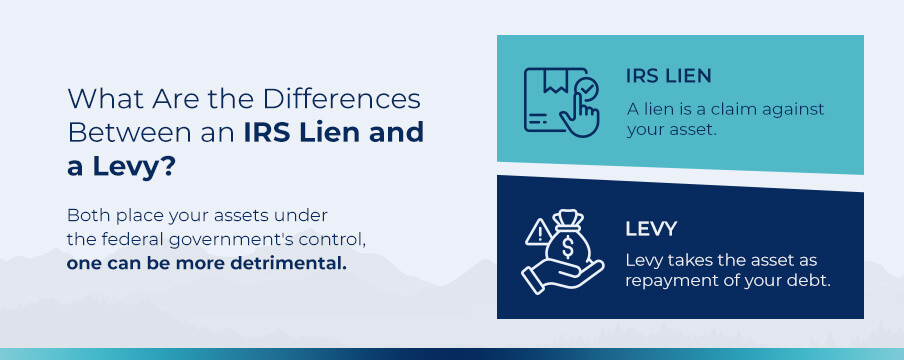
The key difference between a tax lien and a levy is that a lien is a claim against your assets, whereas a levy actually takes the asset as repayment of your debt. When you receive an NFTL, you have the right to appeal based on the IRS Publication 1660 Collection Appeal rights.
How Does a Lien Affect Your Finances?
When the government issues a lien against you to claim back unpaid tax debt, it can affect your financial health in the following ways:
- Assets: Since a tax lien covers all your assets and assets you may own in the future, other creditors cannot claim any assets toward their accounts.
- Credit: Until you resolve your tax lien, you may find it challenging to acquire more lines of credit.
- Business: All your assets can be susceptible to a tax lien, including your business, any business property, and incoming accounts or payments.
- Bankruptcy: Even after filing for bankruptcy, you may still be responsible for the tax debt.
What Can the Government Claim or Seize?
When the government issues a tax lien or levy against you, it can claim or seize the following assets:
- Bank accounts: Any personal or business bank accounts are eligible for liens or levies. When you receive a bank account levy, the bank can freeze your account until you resolve the levy, either through payment in full or a relief option, such as a payment plan.
- Real estate: Your personal real estate investments can also be at risk of levy if you have fallen behind on tax payments and missed a lien notice.
- Paychecks: The government can issue a levy for your upcoming paychecks.
- Retirement accounts: A tax levy can also apply to your savings or retirement accounts. The government typically only resorts to seizing your retirement accounts as a last resort.
Can You Avoid a Lien or Levy?
There are two ways to avoid a tax lien or levy:
1. Avoid Falling Behind
Staying up to date may be easier said than done, and there is no shame in falling behind due to your circumstances. To minimize the risk of receiving a lien or levy, do your best to pay your taxes in full and on time. If life gets in the way, consult with a professional to assist in negotiating a relief option with the tax authority.
2. Submit an Appeal
When you receive a tax lien, there is a short window during which you can file an appeal. A relief option can buy you some time, since you can set up a payment plan with the revenue department. Submitting an appeal can be tricky, so the safest course of action is to schedule a tax consultation with a professional.
When Will the IRS Release a Lien?
If you have received a federal tax lien, the IRS has specific conditions to qualify for a release. Here are your options to get rid of a lien:
Settle the Debt
The simplest and fastest way to release a lien is by settling your outstanding tax debt. Once you pay your tax debt in full, the IRS will release your lien within 30 days of receiving payment. Settlement may not always be within your means at the time, which is why you should act fast to submit an appeal or work with a tax consultancy agency to apply for a relief option.
Arrange a Payment Plan
If you cannot settle your tax debt in full when you receive an NFTL, a payment plan can give you the necessary peace of mind. You can apply for a short-term or long-term installment agreement, depending on your financial situation. A short-term payment plan gives you 180 days to settle your tax debt in full, while a long-term plan allows you to pay off the amount in monthly installments.
Discharge a Property
Another relief option available to you is to apply for a discharge of property. If you’re approved, the IRS will remove the lien from the property. However, the IRS must deem a taxpayer’s property eligible for discharge. The experts at BC Tax can apply for a property discharge on your behalf to streamline the process and alleviate some of the stress of tax debt.
Apply for Subordination
Subordination can allow you to gather the funds necessary for settlement by moving other creditors ahead of the IRS. This strategy can provide a way to secure a loan or mortgage from other creditors using your property as collateral. Applying for subordination does not automatically remove the lien. We recommend consulting with an expert to discuss your eligibility and potential outcomes.
Request a Withdrawal
A withdrawal does not remove your tax debt. Instead, the IRS removes the record of the NFTL, so it no longer has a public claim against your property and your other creditors don’t have to compete with the government for repayment. However, the IRS still has the right to collect and can refile a lien if you don’t resolve the debt.
Contact Us for a Tax Consultation
The experts at BC Tax are here to help you through the challenges of releasing a federal or state tax lien from your assets. Contact us to schedule a consultation to explore your options.


Authored by the BC Tax Insights Team, this article reflects the collective expertise and experience of our seasoned tax professionals. The Insights Team at BC Tax comprises specialists with a deep understanding of various tax scenarios and solutions. With a focus on providing informative, accurate, and practical insights, our goal is to guide readers through the complexities of taxation and financial planning. Every piece is crafted with the intent to help individuals and businesses navigate the ever-evolving world of taxes, ensuring clarity and confidence in decision-making.